Folding-Arm Awnings
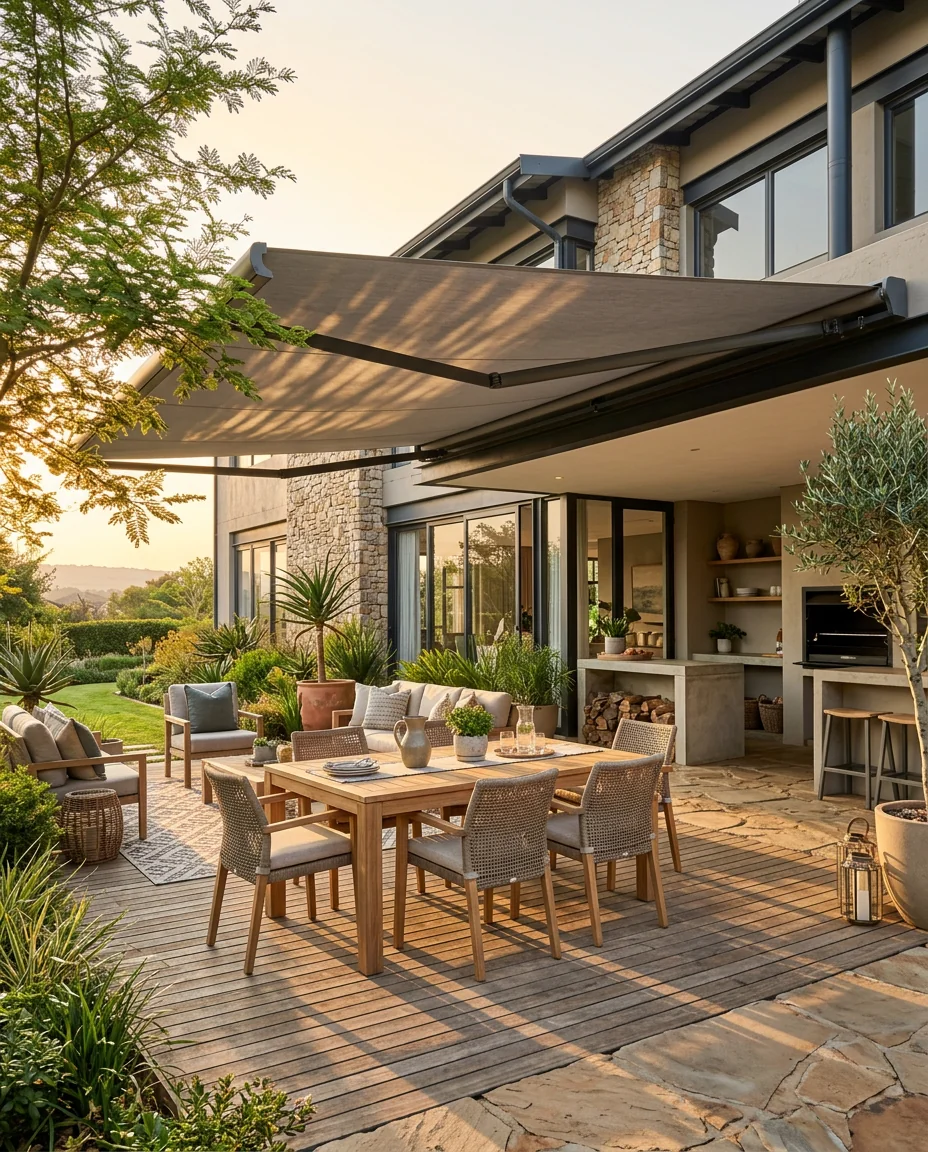
Shade over the braai and entertainment patio on demand — no posts, no permanent roof, gone into a cassette when you don’t need it.
Shade over the braai and entertainment patio on demand — no posts, no permanent roof, gone into a cassette when you don’t need it.
A folding-arm awning is a retractable fabric canopy on spring-tensioned arms, fixed to the wall above the patio and extended out over the entertaining area. There’s no post to work around and nothing permanent overhead — it disappears into its cassette when you want the winter sun through, and comes out in under a minute when the afternoon heat arrives.
For a Fourways entertainment patio — the space every new build treats as a second living room — it’s the single highest-impact product we fit. It turns a west-facing deck from unusable in January to the spot the whole family is in by four o’clock.
“No posts, no clutter around the braai — and it retracts to let the winter sun back in, which a fixed roof never can.”
An awning is a shade product, not a rain product — fine at a pitch in light drizzle, never intended for storm rain or standing water. Wind ratings are real engineering limits, not suggestions, which is exactly why a wind sensor matters on a motorised unit here. The fixing substrate also matters — brick, timber and steel all take the bracket differently, which is one of the things your consultant checks on site during the free measure.
Awnings are priced on the area they shade — width multiplied by projection — and the guide figures, installed, are R3,500 to R5,500 per square metre for a crank-handle unit and R5,500 to R7,500 per square metre for a motorised one. A full cassette, a wind sensor and the wider projections all sit towards the top of each band.
A small awning over a single door still carries a minimum charge, since the arms, cassette and wall fixing are the same job at any width. The written figure for your patio only comes after the free measure, because the wall, the exposure and the projection all have to be seen before they can be priced.
The same retractable, wind-sensored shade for an entertainment patio, fitted in the neighbouring areas we know just as well.